
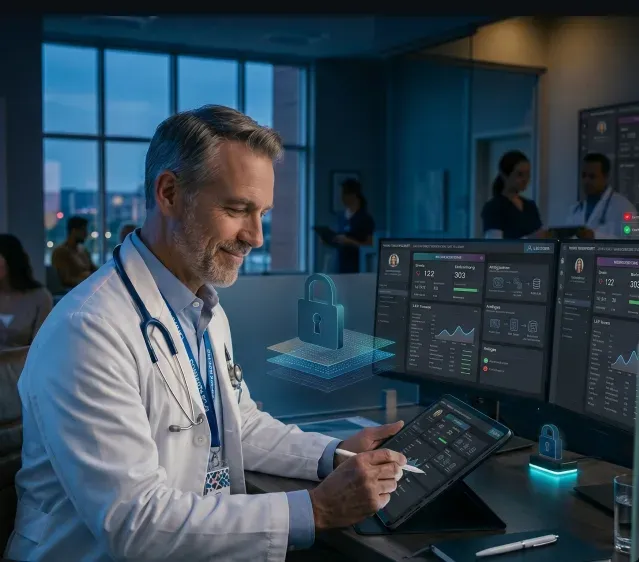
GDPR Checklist for Building Secure Healthcare Applications

By Yokendra Kumar P
DevOps Engineer
Quick Summary
If a healthcare app asks someone to trust it with personal information, that trust has to be earned. Good design helps, but good privacy practices matter just as much. This guide covers the practical decisions that make healthcare apps safer, easier to manage, and better prepared for GDPR expectations in 2026.
Someone downloads a healthcare app because they want something to become easier. Maybe they need to book an appointment without calling the clinic. Maybe they want to see a report, upload a document, or receive a reminder that saves them from missing treatment. Very few people stop to think about where that information goes after they press submit. The organisation behind the app has to think about it instead.
That is why GDPR compliant healthcare app development is not a legal exercise that happens after coding is finished. The choices made during planning often shape how secure and manageable the product becomes years later. Many providers reviewing mobile initiatives also revisit their wider digital infrastructure to make sure every system handles information consistently.
If budget planning is still open, compare this checklist with the guide to healthcare app development cost in the UK.
Why GDPR Starts Before Development
Teams sometimes imagine compliance as a checklist waiting at the end of a project. Real projects rarely work that way. By the time the first screens have been designed, dozens of decisions have already been made about what information will be collected, who can see it, and where it will be stored.
Changing those foundations late in development can be expensive and frustrating. It is usually simpler to ask early questions such as: Do we actually need this information? Who should be able to access it? How long should it remain available? What happens if a patient wants it removed? Those conversations often prevent bigger problems later.
Build Around Real Data, Not Every Possible Data Point
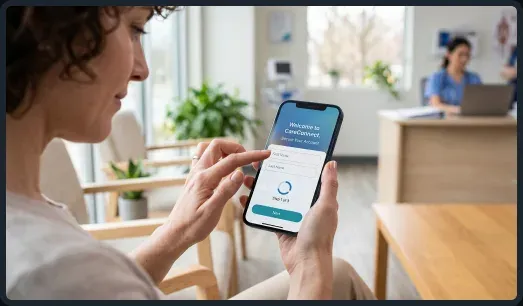
Registration forms have a habit of growing. One team asks for a phone number. Another wants an address. Someone else suggests collecting additional demographic information because it might be useful in the future. Eventually the form becomes longer than it needs to be.
Many successful healthcare apps take the opposite approach. They gather what is genuinely required for the service being offered and avoid collecting information simply because they can. Patients usually appreciate that restraint. Shorter forms feel less intrusive and quicker to complete, while organisations have less unnecessary information to manage over time.
The same principle often appears in patient portal projects, where clarity and simplicity improve both adoption and trust.
Think About Who Needs Access
Protecting information is not only about keeping outsiders away. It is also about making sure authorised users see only what they need for their role. Reception staff, clinicians, administrators, and managers often require different levels of visibility.
Building those distinctions into the application from the start is usually far easier than untangling permissions after launch. Another practical habit is recording important actions automatically. Knowing when information was viewed or changed can be just as valuable as the information itself when reviewing issues later.
The UK Information Commissioner's Office publishes guidance that many organisations use when reviewing their approach to handling personal information.
Connected Systems Need Extra Care
Healthcare apps rarely operate in isolation. Appointment platforms, messaging tools, payment services, reporting dashboards, and patient record systems may all exchange information during a normal day. Those connections can save considerable time, but each one deserves careful planning.
Instead of asking only whether two systems can communicate, it helps to ask what information should move between them and whether every transfer is genuinely necessary. Small design decisions made here often have long-term consequences.
Organisations modernising healthcare software frequently address integrations alongside broader interoperability projects. The NHS continues to promote digital services that improve access while supporting responsible information management.
Integration-heavy projects should also account for EHR and EMR integration planning before implementation begins.
Test the Unusual Scenarios
Most applications perform well when everything goes exactly as expected. The more interesting question is what happens when something unexpected occurs.
What if a session expires halfway through an upload? What if two people attempt to update the same record? What if a notification reaches the wrong device because someone forgot to log out? Looking for these edge cases before launch often uncovers issues that routine testing misses.
Many teams also begin with a smaller release, learn from real usage, and expand gradually instead of trying to deliver every feature on day one. Broader software planning often follows the same measured approach.
Where Trudosys Fits In
Every healthcare organisation has its own way of working. Some rely heavily on digital forms. Others coordinate complex appointment flows or integrate with existing clinical systems built over many years.
Trudosys approaches projects by understanding those existing processes first and then designing software that supports them. Mobile applications, integrations, reporting, and operational workflows are planned together so they make sense in day-to-day use rather than only in technical documentation.
Explore healthcare software development services for connected healthcare app and workflow planning.
Frequently Asked Questions
Final Thoughts
People are unlikely to recommend a healthcare app because it has excellent permission settings or well-structured audit logs. They notice something simpler. The app feels trustworthy. Information appears where it should. Tasks are easy to complete. Nothing unexpected happens with their personal details.
That quiet confidence is often the result of dozens of careful decisions made long before release. The strongest GDPR compliant healthcare app development projects are not remembered for talking about compliance all the time. They are remembered because privacy becomes part of the experience without getting in the user's way. For many organisations, that is exactly what good software should do.
Sources

Yokendra Kumar P
DevOps Engineer
Yokendra Kumar P is a DevOps Engineer with approximately two years of experience in cloud infrastructure, Kubernetes operations, and delivery automation. He works with AWS EKS and DigitalOcean DOKS, using tools such as Terraform, Helm, Jenkins, Argo CD, Docker, and Vault. His experience includes infrastructure automation, GitOps deployments, observability, and DevSecOps practices. He focuses on improving the reliability and efficiency of cloud-native applications through repeatable deployments and well-managed infrastructure.
Professional Experience: Approximately 2 years.
Industry and Project Experience: Cloud infrastructure, DevOps, platform engineering, Kubernetes operations, and DevSecOps.
Technical Expertise: AWS EKS, DigitalOcean DOKS, Kubernetes, Terraform, Helm, Jenkins, Argo CD, Docker, Vault, observability tools, CI/CD automation, and GitOps.