

What Is Business Process Automation and Why Does It Matter?

By Talari Madhavi
Software Engineer
Quick Summary
Business process automation uses software to move repeatable work through clear rules, approvals, notifications, and system updates so teams spend less time chasing tasks and more time making decisions.
Business process automation is the use of software to handle repeatable operational steps such as approvals, onboarding, status updates, notifications, data entry, and reporting. It matters because growing teams lose time when these steps depend on emails, spreadsheets, and manual follow-up.
Take a normal working day in almost any business.
A customer places an order. Someone checks inventory. Another team approves it. Finance needs the same information, while operations wait for confirmation before moving to the next step. None of these activities are difficult on their own, but together they involve a surprising amount of back-and-forth.
That pattern repeats across almost every department.
HR follows up on onboarding documents. Sales waits for approvals before sending proposals. Purchase requests move through email chains. Managers ask for status updates because the latest information sits in someone's inbox instead of a shared system.
This is exactly where business process automation makes a difference.
It doesn't replace the people doing the work. Instead, it takes care of the repetitive actions that keep slowing everything down.
As organisations grow, many also begin reviewing how different departments work together instead of treating every team as a separate operation.

Check out the services provided by Trudosys.
For a deeper industry example, read what typically breaks inside manufacturing operations as they scale.
Business Process Automation Starts With Everyday Work
When people hear the word automation, they often imagine something highly technical.
The reality is usually much simpler.
An employee submits a leave request and it automatically reaches the correct manager.
A completed sales order creates a task for the warehouse.
A customer receives a confirmation message without someone manually writing the email.
An invoice moves to finance once approval is complete.
These small actions happen hundreds of times every week inside most businesses.
When software handles them automatically, work keeps moving without employees constantly checking whether the next person has received an update.
The change may seem small, but across an entire organisation it saves a considerable amount of time.

What Is Business Process Automation?
Simply put, business process automation means using software to handle repetitive business activities that follow a clear sequence of steps.
That might include:
- Employee onboarding
- Leave approvals
- Customer onboarding
- Purchase requests
- Invoice approvals
- Inventory updates
- Internal notifications
- Report generation
People still make decisions where judgement is needed.
The software simply removes the repetitive coordination surrounding those decisions.
Instead of chasing updates or copying information between systems, employees spend more time completing meaningful work.
Where Most Businesses Begin
Very few companies automate everything at once.
They usually begin by looking for work that creates the most unnecessary effort.
Perhaps the same information is entered into multiple systems.
Maybe approvals spend days sitting inside inboxes.
Sometimes reporting takes hours because data has to be collected from different departments.
These are often the first opportunities for automation.
Once those workflows become more reliable, businesses usually expand into other areas based on what delivers the greatest operational value.
Many organisations also combine automation with custom software development so the technology reflects existing business processes instead of forcing people to change how they work.
Better Workflows Lead to Better Decisions
Saving time is usually the first benefit people mention.
It certainly matters.
Another benefit becomes obvious after the system has been running for a while.
Information becomes easier to trust.
When updates happen automatically, managers no longer need to wonder whether they're looking at yesterday's spreadsheet or last week's report.
Production teams see current information.
Finance works from the same data as operations.
Sales doesn't need to call another department just to confirm whether something has already been completed.
That shared visibility often changes the quality of decisions just as much as the speed of the work itself.
Research continues to show that organisations adopting workflow automation improve operational efficiency while reducing repetitive administrative work.
Why Business Process Automation Matters More Than Ever
Business operations rarely become simpler over time.
Companies add more employees.
More customers.
More suppliers.
More approvals.
More software.
Eventually people spend a large part of their day coordinating work instead of actually doing it.
That is why business process automation has become an important investment across industries including healthcare, manufacturing, hospitality, logistics, education, and professional services.
The goal is not to automate everything.
It is to remove the repetitive work that prevents people from focusing on work that genuinely needs experience and judgement.
Digital transformation studies continue to show that workflow automation remains one of the biggest drivers of operational improvement across growing organisations.

Healthcare teams facing this pressure can also review the Smile Dental automation case study for a practical example of reducing appointment and communication admin.
When a task requires interpretation rather than a fixed rule, this small-business AI pilot checklist explains how to evaluate it alongside the existing workflow. For the wider investment decision, compare configuration, integration, and custom development.
Where Trudosys Fits In
No two businesses organise work in exactly the same way.
Approval processes differ.
Reporting requirements differ.
Customer journeys differ.
Even companies in the same industry often have completely different operational workflows.
For that reason, Trudosys starts by understanding how work already moves through the organisation. From there, automation is designed to support those existing processes instead of replacing them with rigid templates.
Whether the requirement involves approvals, internal workflows, reporting, customer operations, or department-wide automation, the objective stays the same: reduce repetitive work while making everyday operations easier to manage.
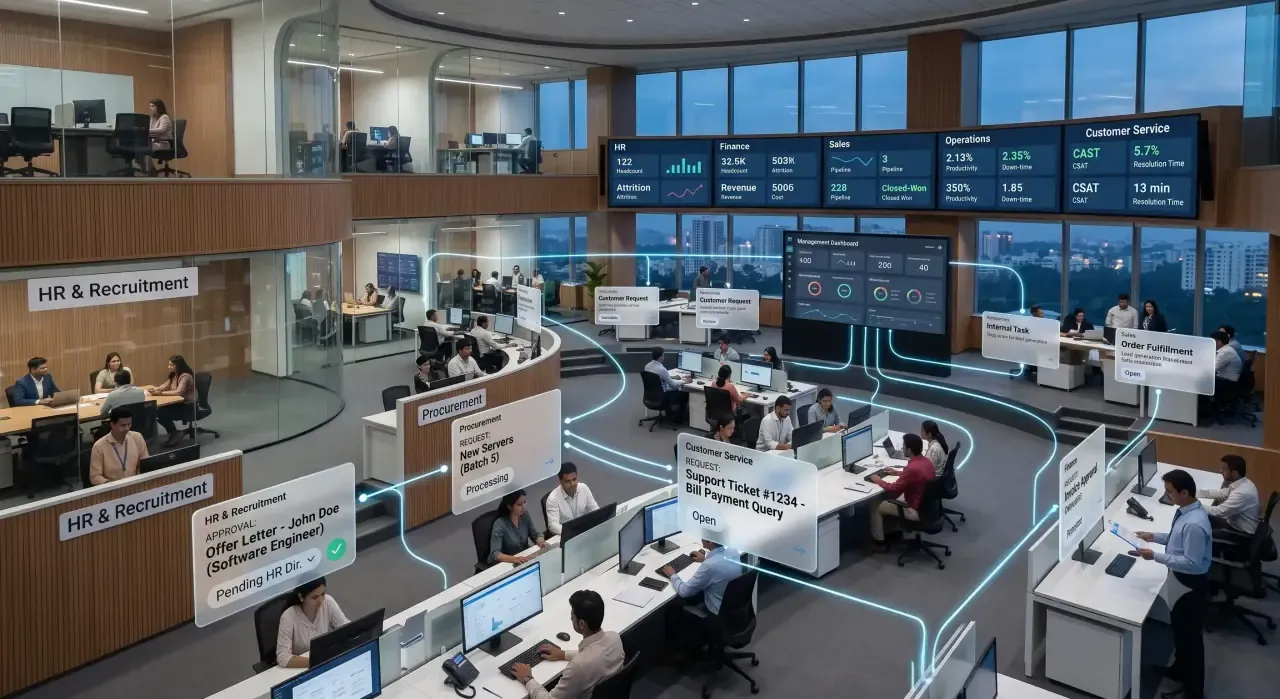
Businesses looking to modernise operational workflows can learn more here.
For organisations wanting to know more on HR workflow automation.
Frequently Asked Questions
Final Thoughts
Most businesses don't notice how much time is lost until they start removing the small tasks that interrupt the day.
An approval happens without a reminder.
Information reaches the next department automatically.
A report is already available when someone needs it.
Individually, those improvements seem minor.
Together, they create smoother operations that are easier to manage as the business grows.
That is why business process automation continues to matter in 2026. It is less about replacing people and more about helping them spend their time where it creates the greatest value.

Talari Madhavi
Software Engineer
Talari Madhavi is a Software Engineer with nearly three years of experience developing and maintaining Java and Spring Boot backend applications. Her work spans CRM, sales and lead management, and property and community management systems. She has experience with microservices, REST APIs, multi-tenant architecture, asynchronous processing, and third-party integrations. Her responsibilities also include authentication, search, caching, production support, debugging, and performance optimization, with a focus on maintaining dependable backend services for business applications.
Professional Experience: Nearly 3 years.
Industry and Project Experience: Backend software development, CRM, sales and lead management, and property and community management.
Technical Expertise: Java, Spring Boot, microservices, REST APIs, multi-tenant systems, asynchronous processing, search, caching, authentication, third-party integrations, debugging, and performance optimization.