

Why Growing Companies Move to Custom HR Automation Software

By Talari Madhavi
Software Engineer
Quick Summary
Custom HR automation software helps businesses simplify everyday HR work. From hiring and onboarding to leave requests, approvals, and employee records, the right system reduces manual work and keeps processes moving. This guide explains why more companies are choosing custom HR automation software in 2026 and what to consider before building a solution.
When a new employee joins the company.
- HR creates the profile.
- Payroll needs the same information.
- IT waits for approval before creating accounts.
- The manager asks when equipment will arrive.
- Finance needs documentation.
- None of those tasks are particularly difficult.
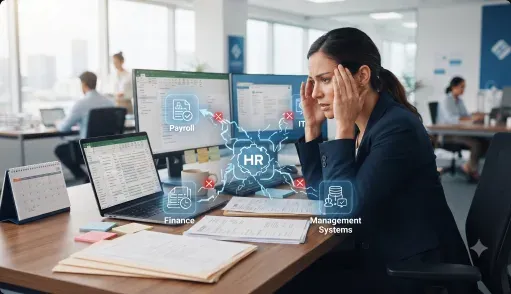
The challenge is that they often happen across different systems, different spreadsheets, different inboxes, and different people.
That is one reason more organisations are investing in custom HR automation software. They are not simply trying to automate paperwork. They want work to move more naturally from one team to the next without constant follow-ups and manual coordination.
Many businesses approaching HR transformation are also reviewing broader business software so every department operates on connected workflows instead of isolated tools.
That same operational foundation is covered in what UK businesses must fix before 2027.
HR Has Changed Faster Than Most Systems
The responsibilities of HR look very different today. Hybrid work, distributed teams, skills-based hiring, AI-assisted recruitment, and continuous learning have changed how organisations manage people.
HR leaders are increasingly expected to support workforce planning and business strategy rather than only administrative tasks.
Many organisations still rely on processes designed years ago. Someone downloads a form. Another person approves it by email. Information is copied into multiple systems.
Eventually everything gets updated, but only after several people have already touched the same task.
The issue is rarely a lack of effort. The workflow itself has simply become too fragmented.
The Problem Isn't Manual Work Alone

People often assume automation exists to eliminate manual tasks.
That is only part of the picture. The bigger issue is what happens between those tasks.
A document sits in someone's inbox waiting for approval. A manager forgets to confirm an onboarding request.
Payroll receives information later than expected. Recruitment updates never reach another department.
Small interruptions like these appear harmless until they happen hundreds of times every month.
That is why many companies are looking beyond generic HR platforms and investing in custom HR automation software that reflects how their teams actually work instead of forcing everyone into predefined processes.
Many of the same principles can be seen in broader workflow automation projects where connected systems quietly remove repetitive coordination.
Every Business Runs HR Differently
Two organisations may use the same HR software while managing completely different approval structures.
One company might need three levels of approval for recruitment. Another could automate the entire process.
Some businesses manage shift workers across multiple locations. Others support remote teams working across different countries.
Trying to fit every organisation into one workflow usually leads to workarounds.
People create spreadsheets. Departments build their own tracking documents. Email becomes the system that connects everything together.
Custom software takes a different approach. Instead of asking people to change established processes, the software is built around the way the organisation already operates.
That flexibility becomes increasingly valuable as businesses grow.
Better Employee Experiences Start Behind the Scenes
Employees rarely think about HR software.
They simply notice when things work. Leave requests are approved quickly. Documents appear where expected. Onboarding feels organised.
Performance reviews happen on time.
Behind those experiences are connected workflows rather than dozens of manual reminders.
Recent HR research also points toward organisations redesigning work around skills, AI-supported workflows, and better employee experiences rather than focusing only on administrative efficiency.
The result is not only faster HR operations.
It is a more consistent experience for everyone involved.

Growth Makes HR Complexity More Visible
Processes that support fifty employees may struggle when the business reaches five hundred.
- More people means more approvals.
- More recruitment.
- More policy updates.
- More compliance.
- More onboarding.
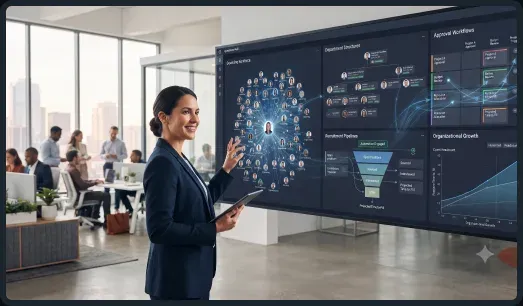
Without connected systems, HR teams often spend increasing amounts of time coordinating work instead of supporting people.
This is one reason businesses are investing in automation that can scale alongside organisational growth rather than rebuilding processes every few years.
Companies adopting AI and automation are increasingly combining technology with human oversight instead of trying to replace HR teams altogether.
Where Trudosys Fits In
Every organisation has its own HR processes.
Some focus on recruitment.
Others manage complex onboarding, compliance, learning, payroll coordination, or multi-level approvals.
Trudosys begins by understanding how those workflows already operate before recommending technology. Instead of asking teams to adapt to rigid software, custom HR solutions are designed to support existing processes while removing repetitive manual work wherever possible.
Businesses exploring wider workflow automation can learn more about our services.
For a broader operations lens, review how businesses can improve operational efficiency.
Organisations interested in broader operational automation may also find further useful insights here.
Frequently Asked Questions
Final Thoughts
The companies benefiting most from HR automation are not necessarily the ones using the most software.
They are the ones reducing unnecessary handovers, duplicated work, and disconnected processes.
That is why custom HR automation software continues to gain attention in 2026.
Good HR systems do more than automate forms.
They help information move smoothly, support better employee experiences, and give HR teams more time for work that genuinely needs a human conversation.
As organisations continue to grow, those quiet operational improvements often become some of the most valuable investments they make.

Talari Madhavi
Software Engineer
Talari Madhavi is a Software Engineer with nearly three years of experience developing and maintaining Java and Spring Boot backend applications. Her work spans CRM, sales and lead management, and property and community management systems. She has experience with microservices, REST APIs, multi-tenant architecture, asynchronous processing, and third-party integrations. Her responsibilities also include authentication, search, caching, production support, debugging, and performance optimization, with a focus on maintaining dependable backend services for business applications.
Professional Experience: Nearly 3 years.
Industry and Project Experience: Backend software development, CRM, sales and lead management, and property and community management.
Technical Expertise: Java, Spring Boot, microservices, REST APIs, multi-tenant systems, asynchronous processing, search, caching, authentication, third-party integrations, debugging, and performance optimization.