

Why UK Businesses Are Rethinking Technology Investments in 2026

By Navineshraj R
Software Development Engineer L-2
Quick Summary
Technology is still one of the biggest investment areas for UK businesses. What's changing is the reason behind those investments. Instead of buying more software, many businesses are looking for technology that actually makes everyday work easier. This guide explores why that shift is happening and why custom software is becoming part of long-term business planning.
A few years ago, improving a business often meant buying another software product.
A new CRM. A project management tool. Something for finance. Something for reporting.
The thinking was simple. Better software would lead to better operations.
Sometimes it worked exactly like that.
Other times, the new software simply became another place employees had to log into every morning.
After a while, businesses started noticing a pattern.
They had plenty of software already.
People were still copying information between systems.
Teams were still chasing updates.
Simple jobs still took longer than they probably should have.
That's why the conversation has changed.
Instead of asking what software they should buy next, businesses are asking whether the software they already have is actually helping people work better.
For many, that's turning out to be the more important question.

Technology Spending Looks Different Today
Businesses haven't stopped investing in technology.
They're just becoming more selective.
Instead of looking for another platform, they're looking much more closely at how work actually gets done during the day.
Maybe people are entering the same information twice.
Maybe teams are waiting for updates that should already be available.
Or maybe everyone is using different systems that don't quite work together.
Those are the kinds of problems businesses are trying to solve now.
Sometimes the fix is new software.
Quite often, it's making existing software work better together.
Those improvements don't always look exciting from the outside.
Inside the business, they usually make everyday work much smoother.

More Software Doesn't Always Mean Better Operations
It's fairly common for growing businesses to build up a collection of software over the years.
Sales has one platform.
Finance has another.
Operations uses something else.
HR has its own tools.
Each system probably made sense when it was introduced.
The trouble starts when none of them share information very well.
People end up copying data from one place to another.
Someone downloads spreadsheets because it's quicker than trying to connect two systems.
Departments keep asking each other for information that already exists somewhere else.
Nobody sets out to build that kind of process.
It usually happens little by little.
Businesses Want Technology That Fits Their Work
Every business has its own way of operating.
Some have longer approval processes.
Some need detailed reporting.
Some manage projects very differently from everyone else.
Off-the-shelf software usually covers the basics.
Eventually, though, businesses start running into situations that don't quite fit.
People find workarounds.
Extra spreadsheets appear.
Manual steps creep back into the process.
That's often when custom software starts becoming a practical option.
Instead of asking employees to adapt to the software, the software is designed around the way the business already works.
That tends to make adoption much easier because people aren't being asked to completely change how they do their jobs.
Connected Systems Save More Time Than New Features
Most businesses already have the information they need.
The challenge is getting it to the right people at the right time.
Customer information sits in one system.
Financial data sits somewhere else.
Operations has another platform altogether.
None of those systems are necessarily bad.
They're just working independently.
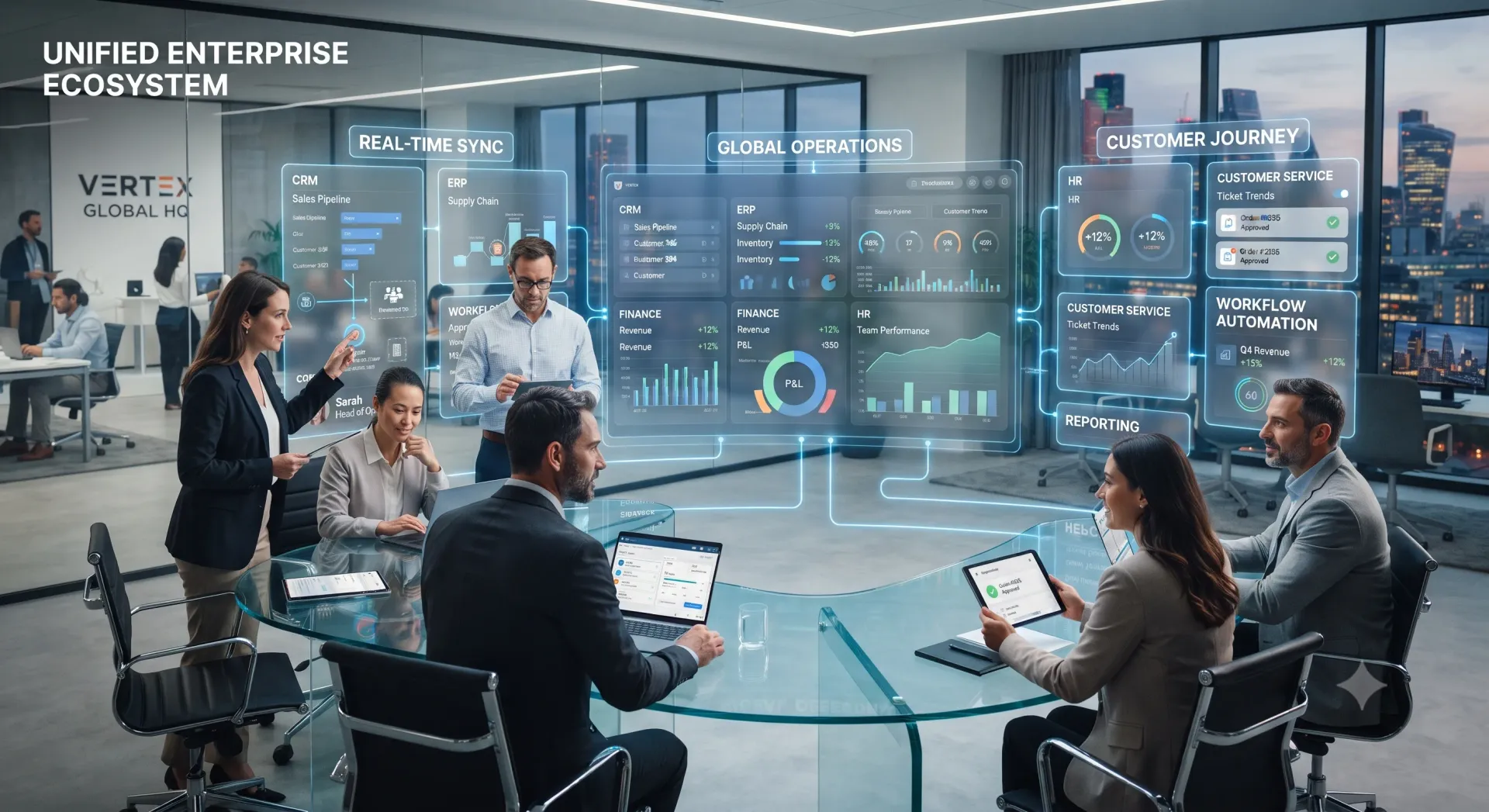
When those systems are connected, a lot of small delays disappear on their own.
People spend less time chasing updates.
Less time entering the same information twice.
Less time wondering whether they're looking at the latest version.
Many businesses also introduce business process automation alongside those connected systems so routine tasks keep moving without someone having to follow up every step.
Decide Whether to Configure, Integrate, or Build
Begin with one operational problem and compare three options against the same requirements.
- Configure an existing tool when the workflow already fits and the gap is permissions, reporting, or team adoption.
- Integrate existing systems when each tool works well but staff repeatedly copy data between them. Confirm API access, record ownership, and how failed updates are recovered.
- Build a focused application when a necessary workflow cannot be supported reliably by configuration or integration. Define the smallest useful release and who will maintain it.
For each option, record setup effort, recurring charges, migration work, support ownership, and a measurable acceptance condition. For example, an approved order should reach operations once, with its status visible to the original team. Include the cost of training and exception handling in the comparison.
Use the custom software cost guide to structure the budget and the manual-work cost assessment to establish the baseline. Those inputs make a purchase decision easier to assess than a feature checklist alone.
Custom Software Is Becoming a Long-Term Investment
Businesses aren't only solving today's problems anymore.
They're thinking about what happens as they grow.
Will the software still fit?
Will new systems connect easily?
Will employees still be relying on manual work two or three years from now?
Those questions matter because changing software every few years is expensive and disruptive.
More businesses are choosing solutions they can continue building on instead of replacing.
That's one reason custom software is becoming part of long-term technology planning across the UK.
How Trudosys Helps UK Businesses
No two businesses work in exactly the same way.
Some want better reporting.
Some need to automate repetitive processes.
Others simply want the systems they already own to communicate properly.
That's where Trudosys begins.
The starting point isn't a list of products.
It's understanding how the business operates today.
From there, software is built around existing workflows, helping teams spend less time managing systems and more time getting work done.

Frequently Asked Questions
Final Thoughts
Technology isn't something businesses invest in just because everyone else is doing it.
They invest because they're trying to solve real operational problems.
Sometimes that means buying new software.
Sometimes it means making better use of what they already have.
The businesses getting the best results are usually the ones that keep things simple.
Their systems work together.
Their teams spend less time moving information around.
And everyday work becomes a little easier without anyone really having to think about it.

Navineshraj R
Software Development Engineer L-2
Navineshraj R is a Software Development Engineer L-2 with three years of experience spanning an internship through his current engineering role. He develops web and mobile applications using React, Flutter, and Python, with involvement across product design, implementation, deployment, and optimization. His work includes application architecture, CI/CD automation, cloud solutions, and workflow modernization. He is also expanding his knowledge of AI and machine learning integration, building on a practical foundation in full-stack software delivery.
Professional Experience: 3 years, spanning an internship through the Software Development Engineer L-2 role.
Industry and Project Experience: Software and information technology, full-stack web and mobile applications, deployment automation, and cloud solutions.
Technical Expertise: React, Flutter, Python, application architecture, UI/UX implementation, CI/CD automation, deployment, and performance optimization. Developing knowledge of AI and machine learning integration.