

The Hidden Tax UK Businesses Are Paying Every Day Without Realising It

By Talari Madhavi
Software Engineer
Quick Summary
Not every business cost appears in a financial report. Some of the biggest losses come from slow approvals, manual work, disconnected systems, and everyday operational delays. This guide explains where these hidden costs come from and how businesses can reduce them through better workflows and connected software.
Most business owners know exactly how much they spend on salaries, software, insurance, rent, and utilities.
The harder number to calculate is the money that disappears through everyday operations.
Nobody raises an invoice for waiting on approvals.
No supplier charges you because employees entered the same information twice.
There isn't a monthly bill for searching through emails to find the latest update.
Yet those things cost businesses time every single day.
Over weeks and months, they quietly affect productivity, customer experience, and profitability.
Some business leaders describe this as an operational tax. Not something paid to the government, but a cost created by the way work moves through the organisation.
Many organisations begin reducing these hidden costs by reviewing the systems supporting their day-to-day operations.
How to Measure the Cost of One Manual Workflow
Pick a recurring task, such as copying approved orders into a production plan. For a representative working week, record how often it happens, the hands-on minutes per occurrence, and time spent correcting mistakes. Track waiting time separately so it is not counted as staff effort.
Estimate weekly effort as task volume multiplied by average handling time. Include follow-ups and rework once, using the same measurement method before and after any change. Label estimates clearly; do not treat all released time as a cash saving unless paid costs actually fall.
The result gives you a baseline for an operational efficiency review. If production handoffs cause most of the repeated work, manufacturing workflow software may be more relevant than another reporting tool. Compare the implementation and support effort with the work you expect to remove before committing to a build.
The Cost That Doesn't Appear on Financial Reports
Most operational waste looks perfectly normal.
People send reminders because approvals are delayed.
Teams maintain spreadsheets because systems don't share information.
Managers ask for updates because reporting isn't current.
Employees copy information from one application into another.
Individually, these activities don't seem expensive.
Together, they consume hundreds of hours every year.
The problem is that businesses become used to them.
People adapt.
Workarounds become routine.
Eventually nobody questions whether the process could be simpler.
That is often where the biggest opportunities for improvement are hiding.
Small Delays Become Expensive Over Time
A five-minute delay doesn't stay five minutes.
An approval arrives late.
Production starts later than planned.
Customer updates are delayed.
Another department waits because the previous task has not been completed.
Small interruptions spread surprisingly quickly through a business.
They also create extra work.
Someone follows up.
Another employee checks progress.
Managers step in to resolve issues that could have been avoided altogether.
Many organisations discover that these small operational delays have a bigger financial impact than they first expected.
Busy Doesn't Always Mean Productive
Walk through almost any office and people look busy.
Emails are being answered.
Meetings are taking place.
Reports are being prepared.
Messages keep arriving.
Being busy, however, is not always the same as making progress.
Sometimes employees spend large parts of the day moving information instead of moving work forward.
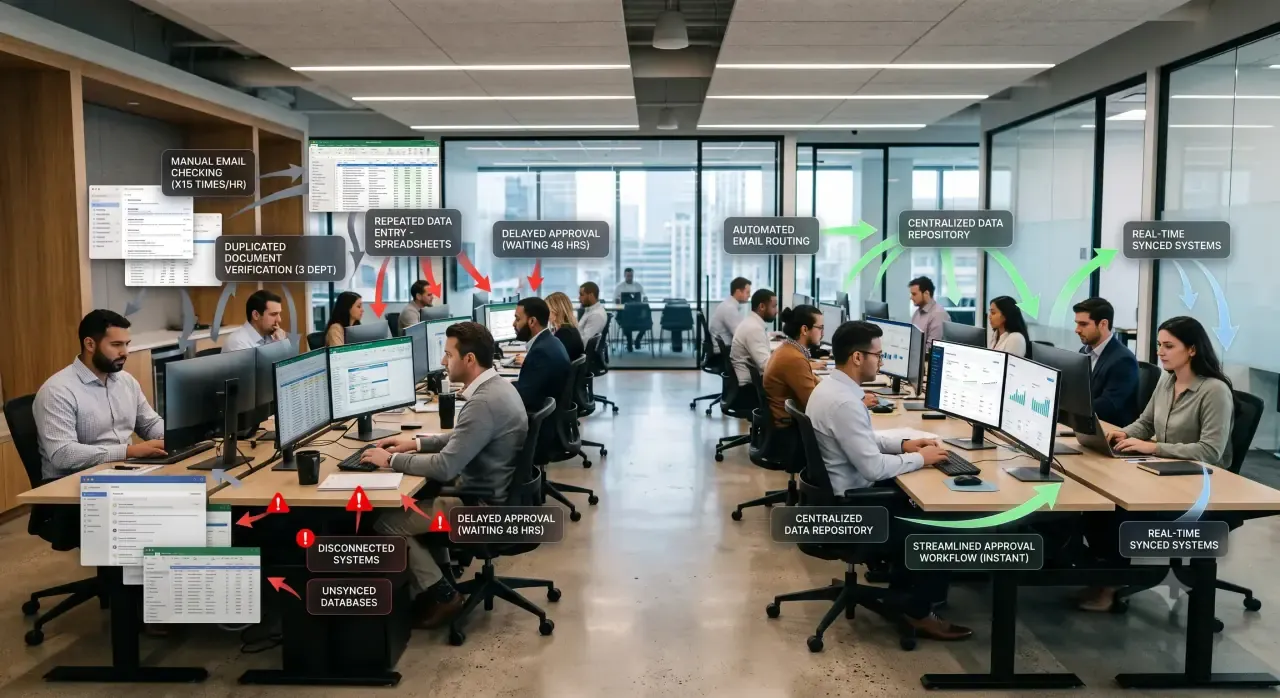
That is where business process automation often delivers the biggest improvements.
Routine approvals happen automatically.
Departments receive updates without someone sending another email.
Information reaches the right people without repeated follow-ups.
Instead of adding more work, the business gradually removes it.
Many organisations begin with one workflow before expanding automation across other departments.
Better Visibility Reduces Hidden Costs
Many operational problems become expensive simply because nobody sees them early enough.
Leaders make decisions using outdated reports.
Departments work from different information.
Teams solve the same problem twice because updates never reached everyone involved.
Connected systems reduce this uncertainty.

Reporting becomes more reliable.
Departments share the same information.
Managers spend less time asking what is happening and more time deciding what to do next.
Use the workflow baseline to check whether better visibility actually reduces follow-ups and repeated administration.
Removing Friction Creates Better Businesses
Businesses often assume they need another tool to become more efficient.
Sometimes they simply need existing systems to work together better.
When routine work flows naturally between departments, employees spend less time coordinating and more time completing meaningful work.
Growth becomes easier because operations are no longer held together by spreadsheets, email chains, and manual reminders.
The businesses improving fastest in 2026 are often not the ones working the hardest.
They are the ones steadily removing unnecessary friction from everyday operations.
Where Trudosys Fits In
Every business has different operational challenges.
Some struggle with approvals.
Others need better reporting, workflow automation, customer management, or stronger visibility across departments.
Trudosys begins by understanding how work currently happens before designing software that supports those existing processes. The aim is not to add more technology. It is to remove unnecessary effort from the way the business already operates.

Businesses looking to simplify everyday operations can explore our services further.
If you're considering workflow automation, this business process automation guide explains where businesses usually see the biggest improvements.
Frequently Asked Questions
Final Thoughts
The hidden tax isn't something businesses pay once a year.
It shows up in small amounts every day.
A delayed approval.
An unnecessary follow-up.
A report prepared by hand.
A task that takes longer than it should because information lives in the wrong place.
Most of these issues seem too small to worry about on their own.
Together, they shape how efficiently a business operates.
The organisations reducing those small points of friction today are often the ones finding it easier to grow tomorrow.

Talari Madhavi
Software Engineer
Talari Madhavi is a Software Engineer with nearly three years of experience developing and maintaining Java and Spring Boot backend applications. Her work spans CRM, sales and lead management, and property and community management systems. She has experience with microservices, REST APIs, multi-tenant architecture, asynchronous processing, and third-party integrations. Her responsibilities also include authentication, search, caching, production support, debugging, and performance optimization, with a focus on maintaining dependable backend services for business applications.
Professional Experience: Nearly 3 years.
Industry and Project Experience: Backend software development, CRM, sales and lead management, and property and community management.
Technical Expertise: Java, Spring Boot, microservices, REST APIs, multi-tenant systems, asynchronous processing, search, caching, authentication, third-party integrations, debugging, and performance optimization.