

Custom Logistics Management Software in 2026: Why More Businesses Are Moving Beyond Off-the-Shelf Solutions

By Santosh Ranbhare
Software Developer
Quick Summary
Running a logistics business isn't just about moving goods anymore. Every order brings inventory, dispatch, customer communication, reporting, and a dozen small decisions with it. This guide looks at why many businesses are moving to custom logistics management software, and how it helps when day-to-day operations start becoming harder to manage than the deliveries themselves.
Ask anyone working in logistics what takes up most of their day and "moving products" probably won't be the first answer. It's checking inventory, following up on delays, updating customers, coordinating drivers, answering internal questions, and trying to keep different systems in sync. None of those jobs are unusual. The problem is that they all happen at once.
Many businesses have added software over the years to solve specific problems. One system manages inventory. Another tracks deliveries. A different platform handles invoices. Reporting happens somewhere else. Eventually, people end up spending more time switching between systems than actually moving work forward.
It's one of the reasons more businesses have started looking at custom logistics management software instead of adding yet another standalone tool. Instead of adding another application, they're looking for software that connects the entire operation.
Why Logistics Has Become More Complex
Customer expectations have changed. Businesses now expect accurate delivery estimates, while real-time shipment updates are becoming normal rather than optional. Supply chains have also become less predictable than they were a few years ago. A delay in one stage often affects everything that follows, which means logistics teams need information quickly instead of waiting for someone to manually update a spreadsheet.
Industry reports continue to show increasing investment in digital logistics, automation, and connected supply chain technologies as organisations look for greater resilience and operational visibility. Technology isn't replacing experienced logistics teams. It's helping them react faster, spot problems earlier, and spend less time chasing information.
One Software Doesn't Fit Every Logistics Business
A regional distributor works differently from a national courier. A warehouse-focused business has different priorities from a manufacturer managing inbound materials. Even two companies in the same industry often follow different operational processes.
That's where many off-the-shelf systems struggle. They offer standard features designed for thousands of businesses. If your workflow doesn't quite match, people create manual workarounds. Extra spreadsheets appear. Information gets copied between systems. Employees adapt because they have to. After a while, those workarounds stop feeling temporary. They simply become part of the job.
Custom logistics management software takes a different approach. Instead of expecting the business to change how it works, the software is built around the business.

Better Visibility Changes Daily Operations
One delayed shipment rarely causes problems on its own. Not knowing about it until three hours later often does.
Visibility is one of the biggest advantages of connected logistics systems. Managers can see where orders are. Warehouse teams know what is arriving. Customer service has the same information as dispatch. Instead of everyone checking different systems, the business works from one source of information.
That doesn't just make reporting easier. It helps people make quicker decisions without spending half the day looking for updates. Many businesses don't realise how much time disappears simply because information lives in different places.
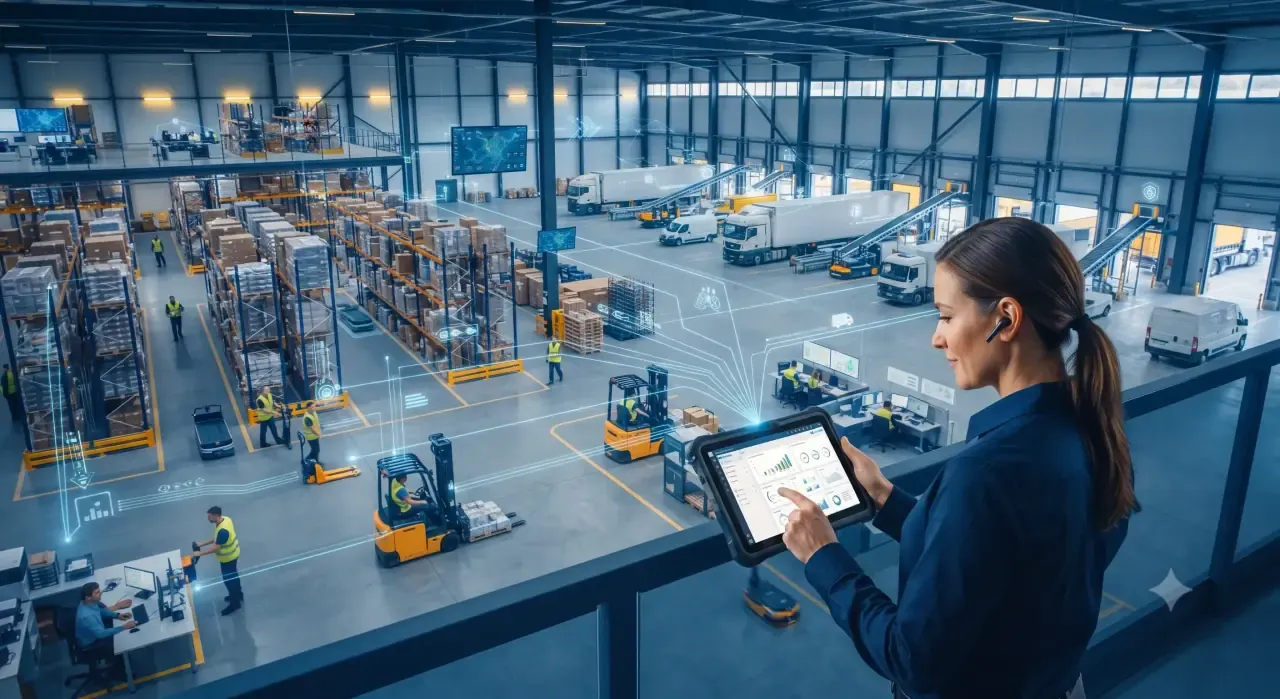
Automation Removes the Everyday Bottlenecks
Most logistics teams don't mind solving difficult problems. They mind solving the same small problem fifty times a day.
Approvals. Status updates. Inventory adjustments. Routine notifications. Manual reporting.
They all matter. They just don't always need someone doing them by hand.
That's where logistics workflow automation usually helps. The routine work keeps moving without someone having to chase every single step. Orders move through defined workflows. Notifications are triggered automatically. Reports update without someone building them manually every afternoon.
Employees spend less time managing processes and more time dealing with the situations that actually need experience and judgement. Businesses exploring broader business process automation often start with logistics because improvements are usually noticeable quite quickly.
Why Custom Logistics Management Software Makes Sense
Growth creates complexity. More customers. More suppliers. More vehicles. More warehouses. More reporting requirements.
Software that worked well for a smaller business often starts showing its limitations as operations expand. Custom software gives businesses room to grow without constantly adding more disconnected tools.
It can work alongside ERP systems, warehouse software, accounting platforms, customer portals, and transport systems. Instead of information being scattered across different applications, everything becomes easier to follow.
Most businesses aren't really buying software. They're trying to make everyday operations less complicated than they were yesterday.
The push towards connected logistics isn't just being driven by customer expectations. Recent OECD research also highlights digitalisation, interoperable systems, and better data sharing as key factors for improving supply chain efficiency and resilience.
How Trudosys Helps Logistics Businesses
Every logistics business has its own way of working. Some need stronger warehouse visibility. Others are trying to get a better handle on transport, inventory, reporting, customer communication, or simply connect software that has never really worked together.
Trudosys develops custom logistics management software around those operational requirements rather than forcing businesses into fixed templates. The result is software that supports day-to-day operations instead of creating extra work.
Learn more about Trudosys' supply chain and logistics solutions. For businesses planning wider operational improvements, check out our services.
Frequently Asked Questions
Final Thoughts
Logistics isn't getting any less demanding. Customers expect quicker updates, supply chains continue to change, and businesses need accurate information much sooner than they did a few years ago.
The companies handling that well aren't always the ones with the biggest software budgets. They're usually the ones whose systems actually work together.
There probably isn't a perfect logistics setup. As a business grows, something will always need adjusting. But when the software fits the way people already work, everyday operations become less frustrating, and that tends to have a bigger impact than most businesses expect.

Santosh Ranbhare
Software Developer
Santosh Ranbhare is a Software Developer with more than two years of experience building Java backend services and enterprise applications. He works with Spring Boot, Spring Data JPA, Hibernate, REST APIs, and microservices, supported by experience with relational databases, caching, search, and messaging tools. His technical background includes PostgreSQL, MySQL, Redis, Elasticsearch, and RabbitMQ. He also has foundational knowledge of AWS, Docker, Jenkins, CI/CD, and system design, complementing his focus on backend application development.
Professional Experience: More than 2 years.
Industry and Project Experience: Software development, Java backend engineering, and enterprise applications.
Technical Expertise: Java, Spring Boot, Spring Data JPA, Hibernate, REST APIs, microservices, PostgreSQL, MySQL, Redis, Elasticsearch, and RabbitMQ. Foundational knowledge of AWS, Docker, Jenkins, CI/CD, and system design.